Mitered vs. Buttseam:
How to Choose Your Waterfall Edge
A waterfall island lives or dies at one seam. Here's what separates the two ways to cut it, what each one actually costs, and how our Perfect Match layout process is what actually makes a mitered one disappear.
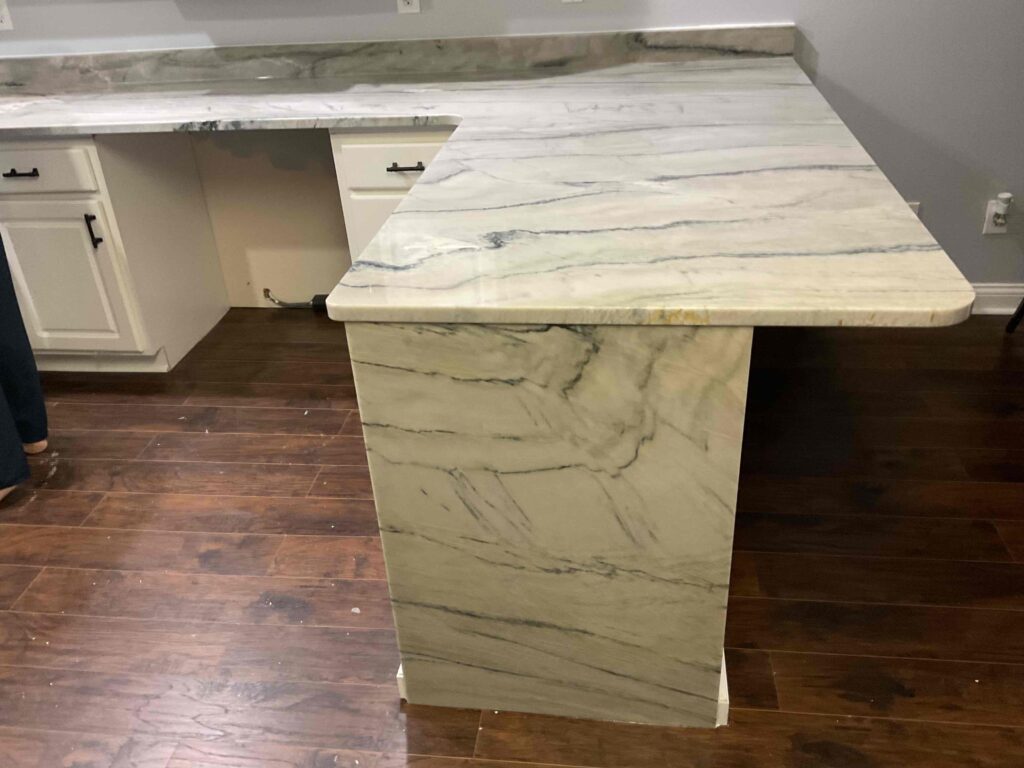

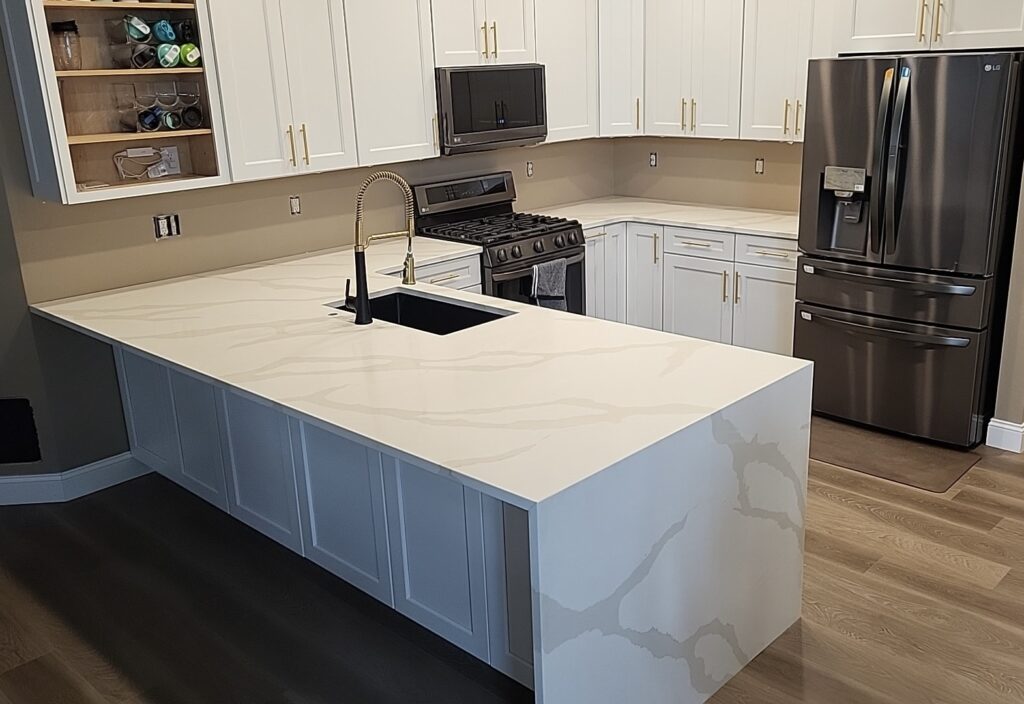
If you've started looking into waterfall islands, you've probably run into two terms that don't get explained very well: mitered and buttseam. Both are ways of joining the countertop to the vertical panel that "waterfalls" down the side of the island. The one you pick decides how the corner looks, what it costs, and how it holds up over time. Here's what actually separates them.
What Is a Waterfall Edge, Exactly?
A waterfall edge is what happens when your countertop doesn't stop at the edge of the island. Instead, the stone keeps going, down the side in one continuous face, all the way to the floor. It reads as a single slab wrapping around a corner, and that corner is the only part of the design that has to be engineered. It gets built one of two ways.
The Two Ways to Join the Corner
Mitered
A mitered edge is made by cutting both the countertop and the vertical panel at matching 45-degree bevels, then joining them so the two beveled faces meet. Done well, the seam closes to a hairline, the kind you'd only find by running a fingernail across it, and the stone's veining can be planned to keep flowing around the corner instead of stopping.
Buttseam
A buttseam, sometimes called a laminated edge, is simpler. The vertical panel is cut square and set directly against the underside of the countertop's overhang, joined in a plain straight line. It doesn't disappear the way a miter does, but on a quieter stone it barely reads as a seam, and it's a meaningfully faster, less expensive install.
Why the Cut Isn't the Hard Part
Any fabricator with the right saw can put a 45-degree bevel on a piece of stone. What actually makes a mitered corner look like one continuous piece of stone, instead of two pieces that happen to meet at a corner, is what happens before the saw touches the slab: matching the direction and movement of the veining on both sides of the joint.
That's what our Perfect Match process is built around. We lay your slab out dry, plan exactly how the pattern will read across the miter line, and get your sign-off before any cutting starts. Skip that step and you can still get a mitered corner, just not the one that made you want a waterfall edge in the first place.
How Perfect Match Works
It's the same three-step process behind every countertop we install, waterfall or not, and it's the reason a planned miter closes to a hairline instead of just a diagonal cut.

Step 1: Your Slab
Walk the actual slab in our showroom and pick the one whose movement you want.

Step 2: Your Layout
Walk the actual slab in our showroom and pick the one whose movement you want.

Step 3: Your New Kitchen
Installed exactly as planned, corner included.
Is a Mitered Corner as Strong as a Buttseam?
Done properly, yes. A mitered joint isn't held together by glue alone, it's typically reinforced from behind with brackets and epoxy, so the connection at the seam ends up stronger than most people expect. The real vulnerability on any waterfall edge, mitered or buttseam, is impact on the exposed vertical panel itself: a kicked-in corner from a hard-soled shoe, a bumped vacuum, or a moved barstool causes far more chips than the joint ever does. Protect the bottom edge the way you'd protect any exposed stone corner, and the joint isn't the weak point.
What Thickness Do You Need?
For a waterfall edge, thicker is better, across every stone type. 3cm gives the corner enough visual mass to look intentional. A thinner slab tends to show its seam and undercut the whole effect a waterfall is supposed to create. If you're set on quartz, granite, or quartzite, plan on 3cm.
Which One Should You Choose?
- Bold, high-contrast veining you want to show off around the corner: mitered, and worth doing through a proper layout process.
- You want the corner to disappear completely: only a planned miter can do that.
- Working with a firm budget: buttseam gets you the waterfall look without the vein-matching upcharge.
- A quieter, more consistent stone: buttseam will barely be visible, and it's the more practical call.