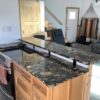
Miter
Two beveled edges join in a diagonal seam so the veins appear to wrap the corner in one continuous piece, if the layout was planned first.

Buttseam
The vertical piece sets flush and square, in a seam that reads straight across. Less material, less time, a lower price than a miter.
Why The Corner Still Shows A Seam
The outer corner is a sharp 90° turn either way, mitered or not. What changes is the seam hidden inside it: a miter bevels each piece to 45° so the seam runs diagonally, closed by veins matched before a single cut is made. A buttseam runs that same seam straight across, honestly, with no attempt to hide it.


Why The Corner Still Shows A Seam
A mitered corner only disappears when the veins are matched before anything gets beveled. Skip that step and you're paying miter prices for a seam that still shows.
✓ Walk the actual slab bundle in person, not a sample chip
✓ Map exactly how the veins will cross the miter before fabrication
✓ Map exactly how the veins will cross the miter before fabrication
✓ Budget for 40 to 60% more slab than the flat finished square footage suggests, since the vertical and horizontal pieces have to come from the same slab to match
✓ Installed so the corner does what it was planned to do: disappear